

If you’ve ever set up a hand washing station on a job site or at an outdoor event, you already know what most of them offer. A foot pump, a tank of cold water, and/or a pump handle that takes a beating. They meet the requirement, more or less, but nobody enjoys using them.
Hot water has been the missing piece, and for an understandable reason. The units that do offer it are usually the large multi-station pods, and those need both a power source and a water source to run. On a half-finished job site or a field at a county fairgrounds, a water source is exactly what you don’t have.
So most crews and event staff settle. They put out a cold water unit, meet the letter of the requirement, and hope people use it.
It doesn’t have to work that way. An outdoor portable hand washing station can carry its own water, heat it on demand, and roll over gravel to wherever it’s needed…which is the gap our new Frontier Series was built to fill. More on that in a moment, but it’s worth starting with what the rules actually require, because that’s where most of the confusion lives.
If you’ve been told you need a hand washing station and you’re not sure what that actually means, you’re in good company. The requirement and the equipment get tangled together often, so it’s worth separating them.
On a construction site, OSHA ties hand washing to portable toilets. If you have portable restrooms on site, you need handwashing facilities as well. Once you have eleven or more hand laborers, that means actual running water, soap, and single-use towels, not hand sanitizer on its own. The general guidance is around one station for every twenty people, though convenience matters more than the minimum in practice. A station nobody wants to walk to is a station nobody uses.
You’ll notice the rule asks for running water, soap, and towels. It doesn’t ask for hot water. So it’s fair to wonder why hot water is worth the trouble.
Cold water doesn’t get hands clean when they’re covered in concrete dust, grease, fertilizer, or fish. Warm water lifts oils that cold water leaves behind, and it’s the difference between a crew that washes properly and a crew that rinses for three seconds and walks away. If you’re running an event with food vendors, your guests notice too.
For food service specifically, health codes are a separate matter from OSHA, and requirements vary by jurisdiction. It’s always worth confirming with your local health official before you rely on any equipment for food-service compliance.
Most portable sinks are designed for a floor. Smooth casters, a cabinet door on the front, a laminate surface…all of which works beautifully in a classroom or a salon, and none of which holds up on a gravel lot in August.
The Frontier’s design decisions came from watching sinks get used in places sinks weren’t designed for. Here’s what changed, and why each piece matters once the sink leaves a building.
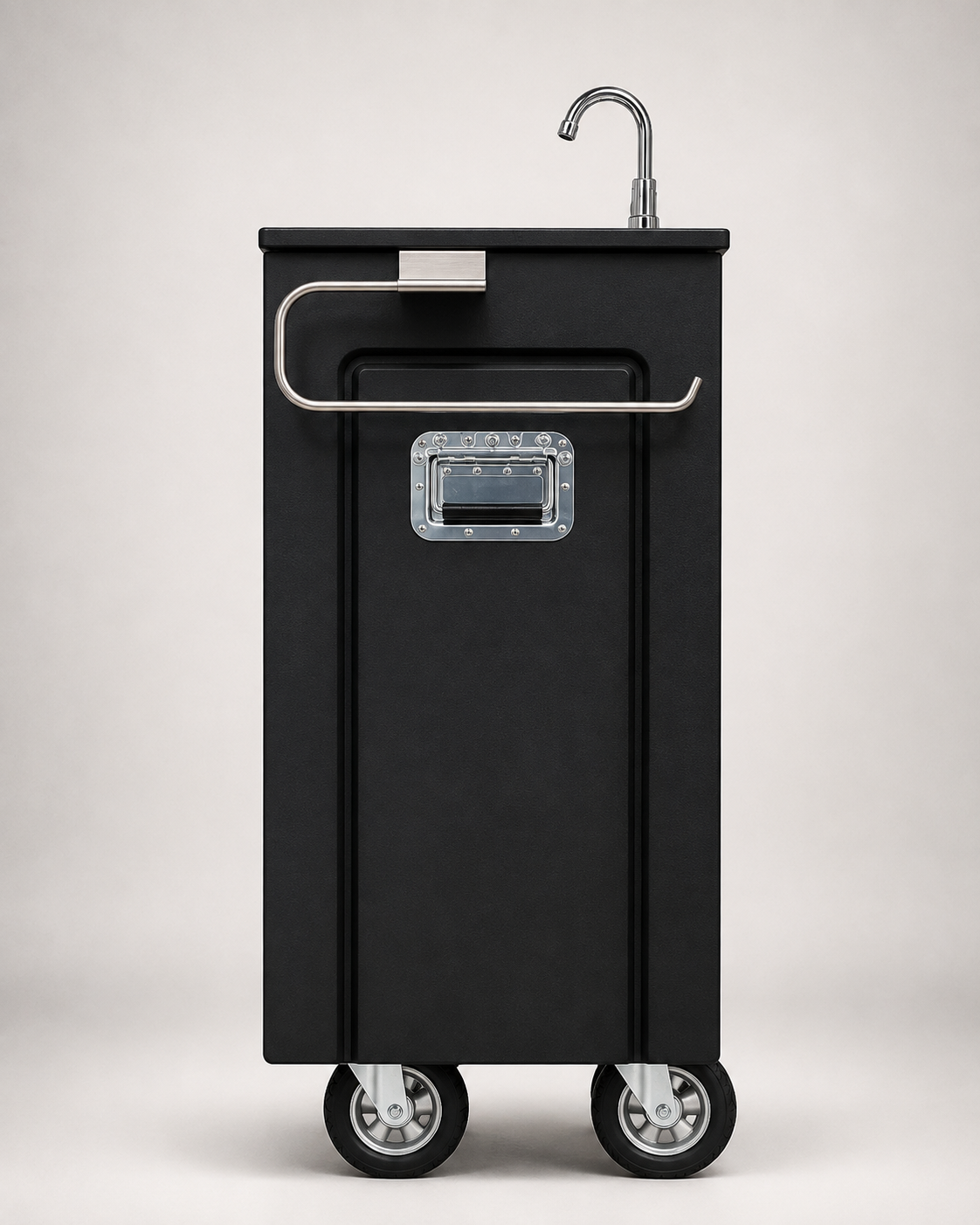
Treaded casters that handle rough ground. A portable outdoor sink lives or dies on its wheels. Five-inch medium-hard rubber wheels with tread, 360-degree spin, and locks. Gravel lots, grass, plywood decking, and loading ramps are all normal terrain for a sink that works job sites and events. Smooth casters stop at the first patch of gravel. These don’t, and the locks mean the sink stays where you put it once it’s in position.
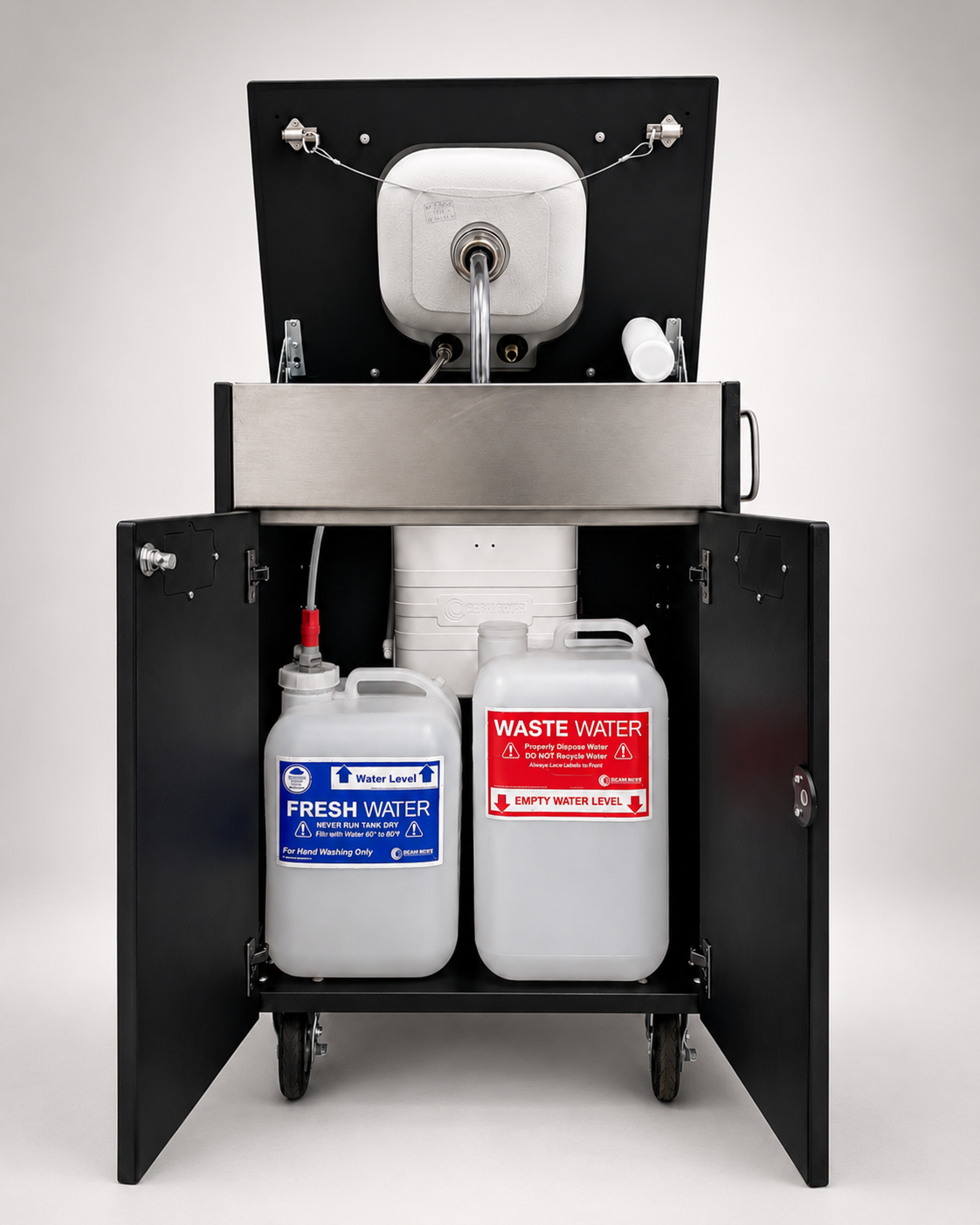
A top-opening countertop. The countertop is hinged and latched, so the whole thing lifts to give you access to the hot water system, the faucet connections, and the soap dispenser. On most portable sinks, you’re reaching through a cabinet door and working blind. Here you open the top, and everything is in front of you, which matters a great deal when you’re servicing a unit between rentals or troubleshooting on site.
HDPE and stainless steel throughout. The cabinet and countertop are high-density polyethylene (HDPE) with a stainless steel basin. HDPE is the material the portable sanitation industry has settled on for good reason. It shrugs off weather, impacts, and cleaning chemicals, and it doesn’t swell or delaminate the way laminate does when water gets into a seam. For anything that lives in a truck and gets unloaded by people in a hurry, that matters.
An attached metal paper towel roll holder. Our first model with one built in. On a job site, this is the difference between meeting the requirement and not, since towels are part of the rule. It also means one less thing to source, mount, and replace.
Top-fill soap dispenser and ADA-compliant wrist-action faucet handles. The soap dispenser fills from the countertop rather than underneath, so refills take seconds.
None of these are dramatic changes on their own. Together they’re what separates a portable hand washing station with hot water that tolerates outdoor work from one that’s genuinely built for it.
| Feature | Frontier Black / Frontier White |
|---|---|
| Cabinet | 25.82″W x 17.82″D x 37.42″H |
| Basin | Stainless steel, 12″W x 10″L x 5.75″D |
| Fresh water tank | 5 gallons, quick-connect |
| Waste water tank | 6 gallons, quick-connect |
| Capacity | Approximately 45–60 handwashings per tank |
| Cabinet material | HDPE and stainless steel |
| Wheels | 5″ locking treaded casters, 360° spin |
| Power | Dedicated, grounded 110V 20A circuit |
| Certifications | SACERS 12, 3.4, 5.1, 5.2; CARB 93120 Phase 2 |
Both colors are the same sink and the same price. Black hides job site grime between cleanings and looks appropriate at an evening event. White reads cleaner and photographs better, which tends to matter for catering, weddings, and anything where the sink ends up in the background of pictures.
If you’re stocking equipment that gets rented out rather than buying for your own site, you’re weighing entirely different things. Utilization, turnaround time, and how many seasons a unit survives being loaded and unloaded by people in a hurry. A few of those considerations worked their way into this design.
One unit works several markets. The same unit can be on a construction site Monday, a wedding Saturday, and a food festival the weekend after. That flexibility is what keeps a unit earning rather than sitting in your facility (and hot water widens the range of jobs it qualifies for).
Fewer service points. The top-opening countertop turns a cramped job into an easy one. Quick-connect tanks mean swapping water between jobs doesn’t require tools or plumbing knowledge from whoever is doing the turnaround.
Materials that survive handling. HDPE and stainless take the knocks that come with loading, unloading, and customers who aren’t gentle. Long rental life is the whole economics of a fleet.
Hot water as a differentiator. Most of what competes with this in a rental yard is a cold water foot pump unit. Being able to offer hot water without needing a water hookup on site is a real selling point to a general contractor or an event producer who has been making do.
No piece of equipment suits every situation, and we’d rather you know the edges before the sink arrives. Three things are worth planning around.
It needs a dedicated 20-amp circuit. This is the big one for outdoor use. The Frontier runs on 110V, but wants a dedicated, grounded 20-amp breaker. Any extension cord needs to be rated for 20 amps or higher, which means 12-gauge wire. On a job site, that usually means temporary power or a generator with the capacity to spare. It’s worth confirming before the sink arrives rather than on the morning of.
Plan your refills around 45 to 60 washes. That’s what five gallons delivers. For a crew of twenty on a full day, expect to refill. A Fill-n-Roll tank dolly makes that considerably less annoying if the water source is any distance away.
Use it outdoors, store it indoors. The Frontier is weather-resistant and built for outdoor work, but it should be set up on level ground and brought inside at the end of the job rather than left out through a storm or a freeze. Treat it like any other piece of powered equipment on site.
Check with your health official for food service. For general handwashing, job site OSHA compliance, and event hygiene, this is a straightforward fit. If you’re relying on it for food-service code compliance specifically, confirm your local requirements first.
Does a construction site need a hand washing station? If portable toilets are on site, yes. With eleven or more hand laborers, OSHA calls for running water, soap, and single-use towels rather than hand sanitizer alone, at roughly one station per twenty workers.
Does a portable hand washing station need a water hookup? Not this one. The Frontier holds its own five gallons of fresh water and six gallons of waste water in quick-connect tanks. It needs a power source, not a water line, which is what makes hot water practical somewhere a water hookup doesn’t exist.
Can it be used outdoors? Yes. It’s designed as a portable outdoor sink for indoor and outdoor use, with treaded locking casters for rough ground and HDPE and stainless construction that handles weather. Set it on level ground and store it indoors when the job is finished.
How many people can use it before refilling? There are roughly 45 to 60 handwashings per five-gallon tank.
What’s the difference between the black and the white? Color only. Same cabinet, same specs, same price.
Can I run it from a generator? It requires a dedicated, grounded 110V 20-amp circuit, so your generator needs to supply that reliably with headroom for anything else drawing from it.
Hot water shouldn’t be the thing you give up because a job site has no water hookup. Warm water gets hands genuinely clean, and clean hands are the whole point of putting a station out there in the first place.
Take a look at the Frontier Series, and if you’d like help working out whether it fits your sites, events, or rental inventory, give us a call at 866.663.1982. We’re happy to talk it through.


Take your time but make sure to save your cart. Drop us your email and we'll take care of the rest!