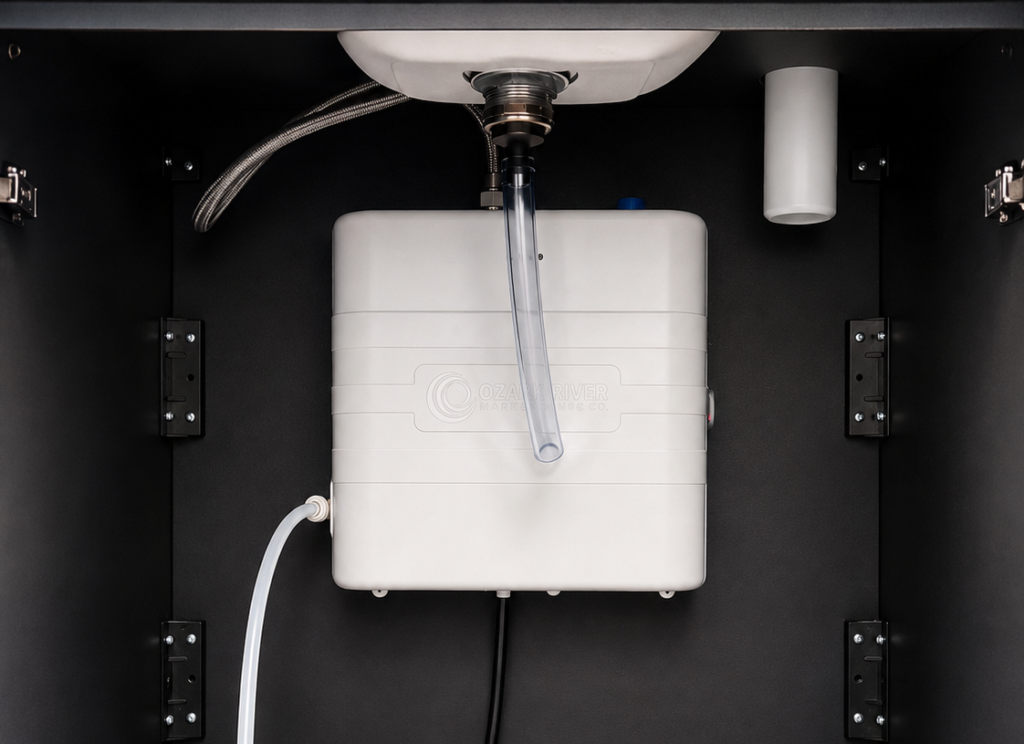

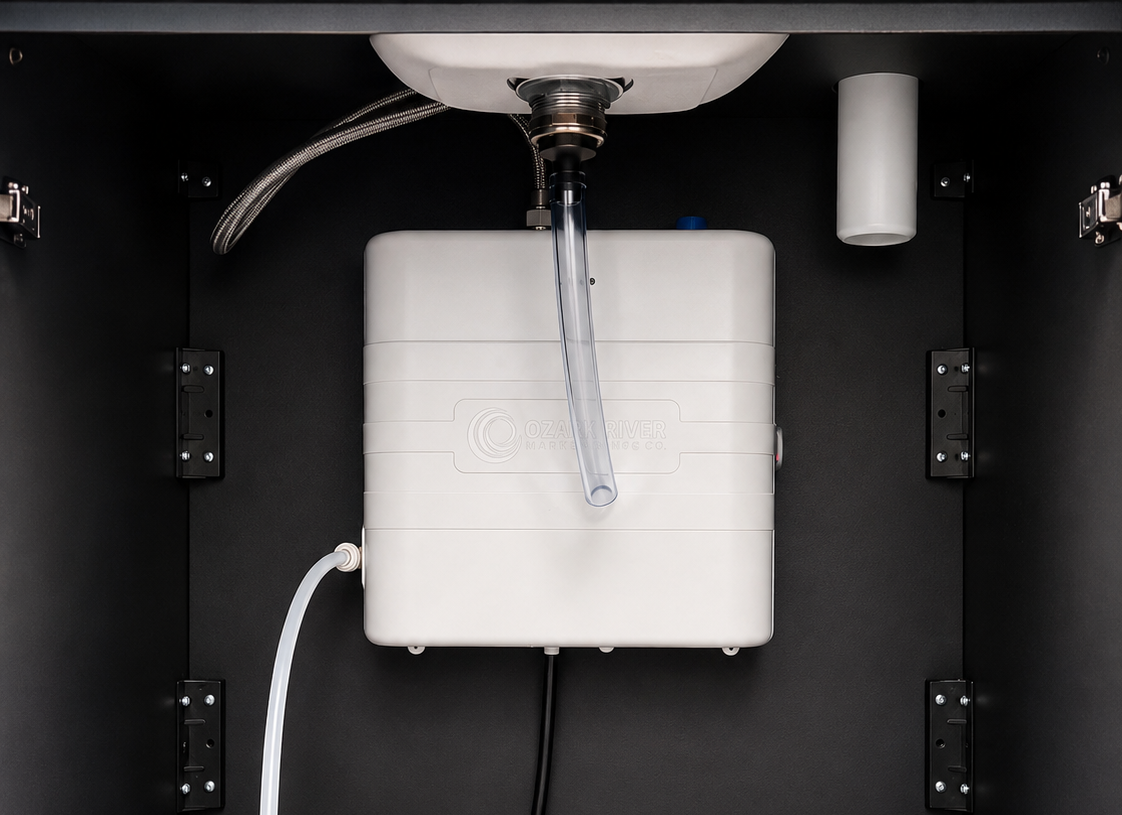

If you’ve ever planned a sink for a spot that doesn’t have plumbing, you know the project tends to stall in the same place. Building the sink itself is manageable. You can cut an opening in a countertop, set a basin into it, and mount a faucet in an afternoon.
Getting water to that faucet is the part that sends people looking for answers.
Most guides you’ll find hand you a shopping list rather than a solution: a water pump, an accumulator tank so the pressure doesn’t pulse, a fresh water tank, a waste tank, food-safe tubing, hose clamps, and a strainer drain. Then there’s the question of hot water, where you’re choosing between a small heater that takes up most of a circuit or a propane unit that needs venting and a pump of its own.
It’s a lot to source for what amounts to one no-plumbing sink kit, and a lot to get working together. Thankfully, the list itself is shorter than it looks, and there are simpler ways to put it together than sourcing every piece separately.
There are four components, and the basin isn’t one of them.
A water pump. Nothing moves without one. In a plumbed sink, pressure comes from the water line. In a DIY sink, a pump has to supply it. On-demand pumps are the most convenient kind, since they sense when you open the faucet and shut off when you close it, so there’s no switch to remember. If you skip the pump entirely and rely on gravity from an elevated jug, you’ll get a trickle rather than a flow, which most people find frustrating after a few days.
A water heater. A point-of-use, tankless water heater is usually the right fit here. Tankless means the water is heated as it passes through rather than stored in a cylinder, so there’s nothing large to find space for and no waiting between uses.
A fresh water tank. Five gallons tends to be the practical size for a cabinet. You’ll fill it from a garden hose, so it’s worth placing it where you can reach it easily.
A waste water tank. It’s best to size the waste tank a bit larger than the fresh tank, generally by at least 15%. That way a completely full fresh tank can never overflow the waste side. This is standard practice in mobile builds, and it’s a good habit to follow at home too.
That’s the whole list. Knowing what to buy isn’t usually the hard part. Getting the pieces to work well together is.
This is the most common disappointment in a DIY sink build, and it’s worth understanding before you buy anything.
Electric water heaters are limited by the circuit they run on. A standard 110V household outlet gives you a fixed amount of power, and every bit of water passing through the heater has to share it. The more water you push through per minute, the less heat each bit receives. Many people only discover this once everything is installed and the faucet delivers water that’s closer to lukewarm than hot.
There are two things that reliably fix it.
The first is keeping the flow rate low. A low-flow aerator on the faucet restricts how much water passes through, which gives the heater time to do its job properly. The second is choosing components that were designed to work together. When the pump, the heater, and the aerator come from three different manufacturers, matching them becomes your problem to solve.
It’s also worth knowing that a standard tankless water heater won’t work on its own with a water tank. Tankless heaters turn on when they sense water pressure coming in, and a tank sitting in a cabinet doesn’t provide any. Without a pump ahead of it, the heater simply never activates. That surprises a lot of first-time builders.
For added convenience, consider a kit where the heater and the pump come as one unit.
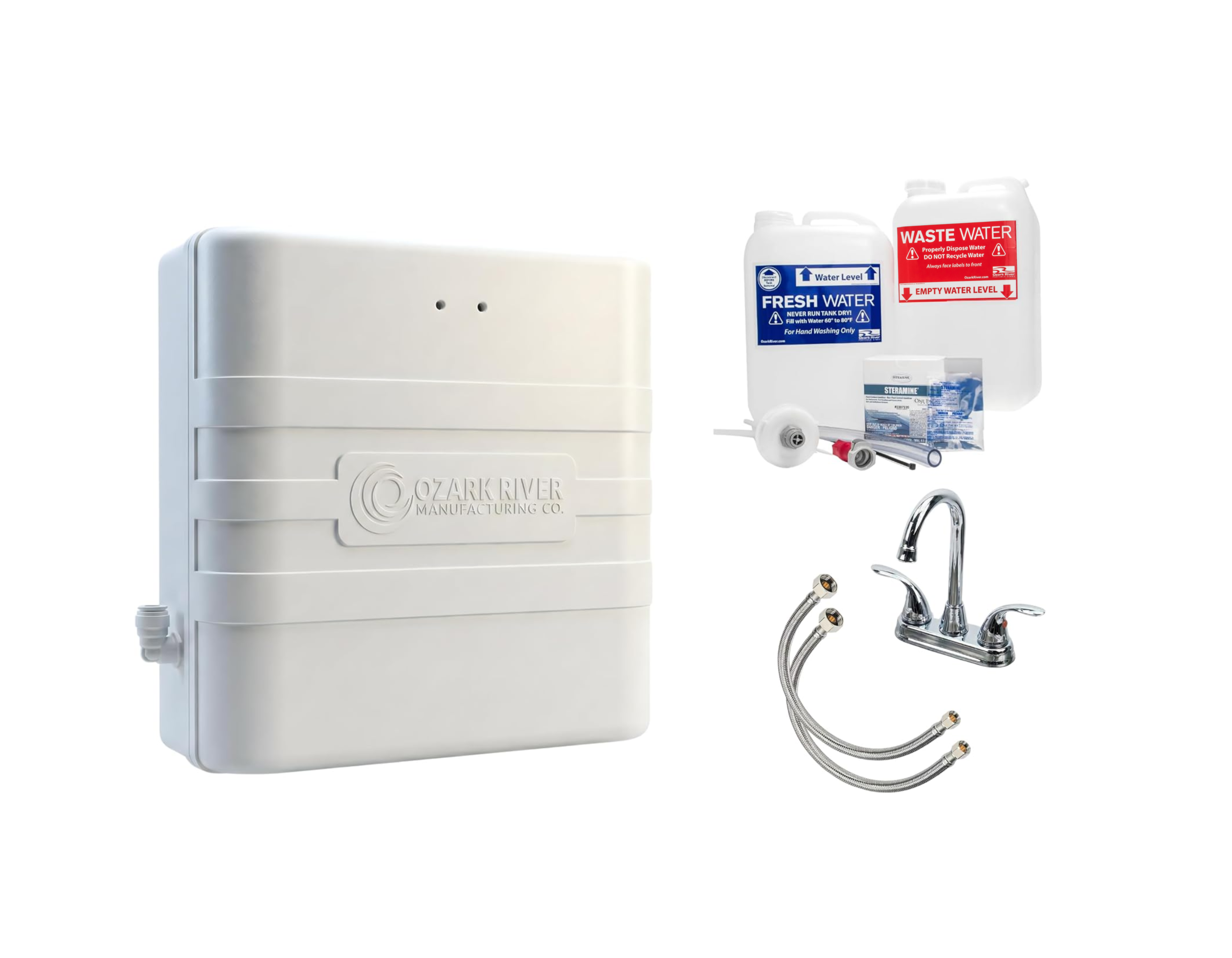
The PRISYM One combines a tankless-style water heater and an on-demand pump inside a single housing that mounts to a wall. The components are matched to each other and to the included low-flow aerator, so the compatibility work is already done. It runs on a standard 110V outlet using a five-and-a-half-foot cord, so there’s no electrician needed and no hardwiring involved.
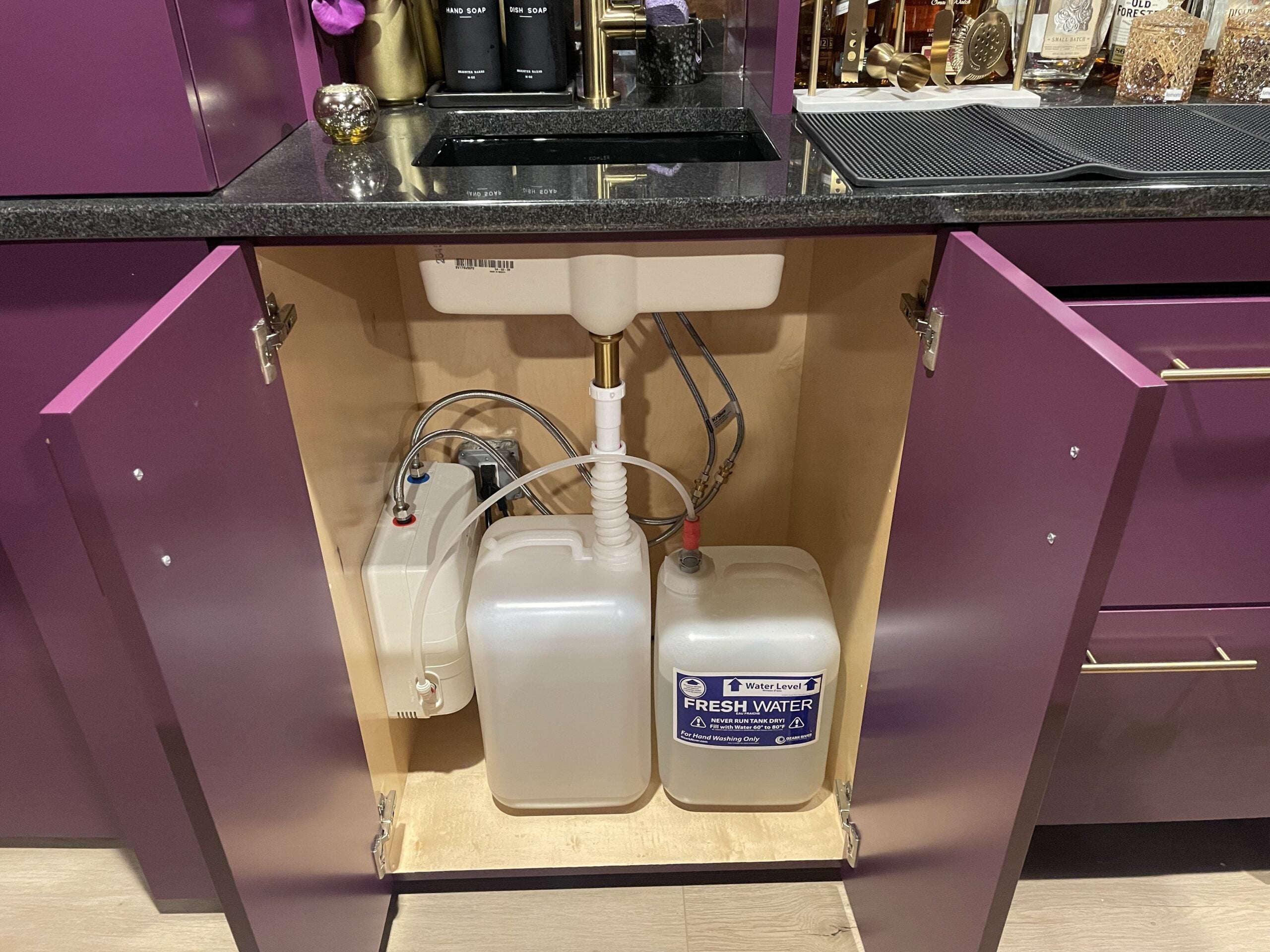
Here’s what you’re working with when you plan your cabinet:
| Specifications | | PRISYM One |
|---|---|---|
| Power | | 110V standard outlet, 1750W, 14.5A max |
| Dimensions | | 11.50″ L x 11.25″ H x 4.75″ W |
| Weight | | 11.5 lbs |
| Maximum water temperature | | 110°F |
| Water flow | | 0.35 GPM |
| Maximum pump vertical lift | | 30″ |
| Inlet/outlet | | 3/8″ push-to-connect / 1/2″ FIP |
| Warranty | | 1 year manufacturer’s |
A few of those numbers will shape your build, so they’re worth noting early. The unit draws 14.5 amps, so a 20-amp circuit is a good idea, and it’s best not to share that circuit with another heavy appliance. The pump lifts water up to 30 inches, which means your fresh water tank needs to sit within about two and a half feet below the unit. The aerator is matched to the heater, so swapping in a higher-flow one is the quickest way to end up with cool water again.
The kit comes in two packages. The PRISYM Plus includes the heater and pump unit, a two-hole faucet with the matched 0.35 GPM aerator, water supply lines, a quick-connect inlet tube, a five-gallon fresh water tank, a six-gallon waste water tank, and Steramine cleaner. You supply the basin and the cabinet. The PRISYM Core includes the same unit and tanks without the faucet and lines, which suits builders who already have a compatible one-hole faucet in mind.
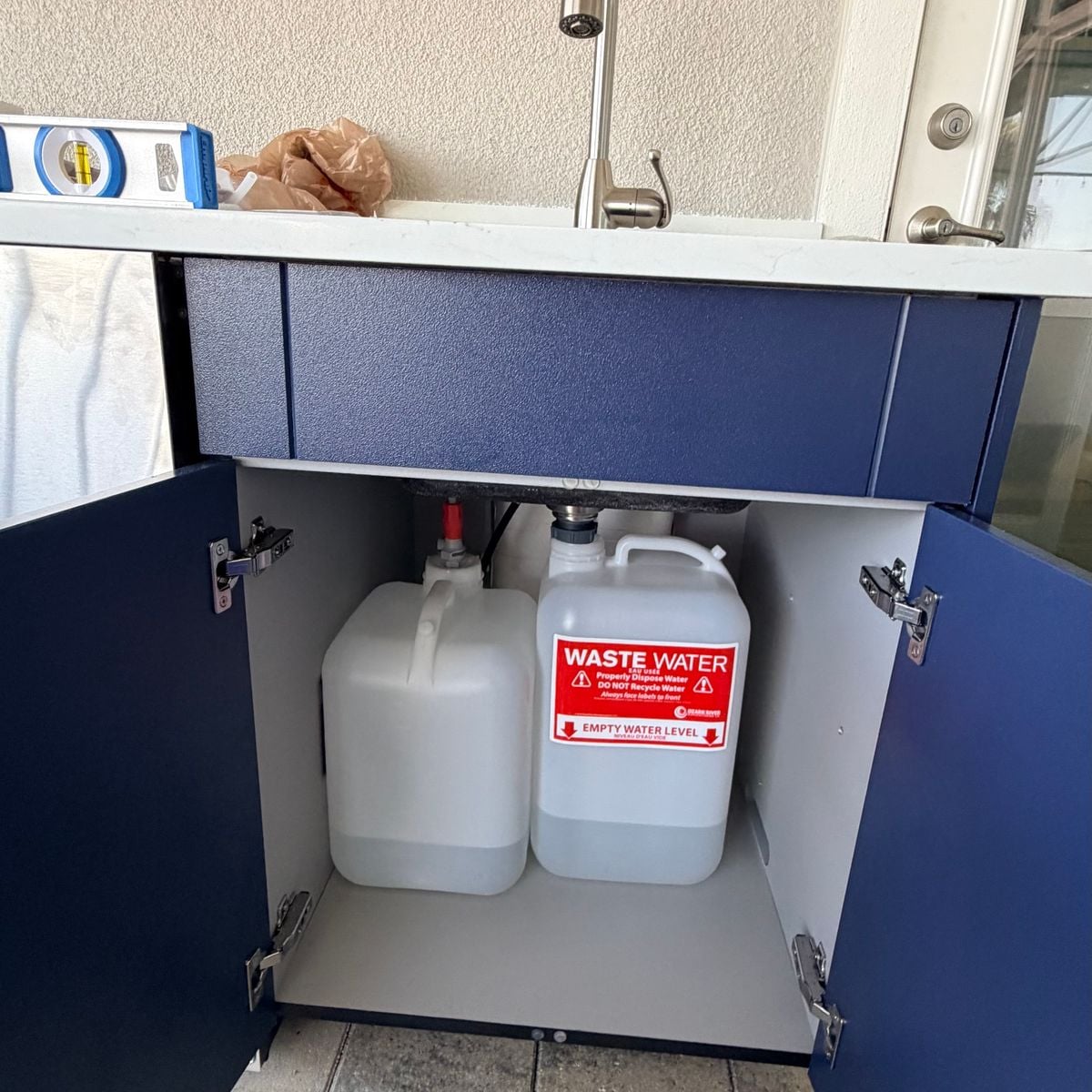
Outdoor kitchens. Outdoor plumbing tends to be the most expensive plumbing, simply because the island usually sits far from the house’s existing water lines. A plumbing rough-in for a single outdoor sink can cost thousands, and properties without nearby connections have seen considerably more once trenching is involved. A self-contained sink system tucks into the cabinet you were already building, so the finished island still looks built-in.
Garages and workshops. A garage sink with no plumbing is one of the most common versions of this project. If your garage has no hookups, adding them usually means running new lines through a slab. Hot water for washing up after a project is one of those conveniences you don’t miss until you have it.
Coffee carts and mobile vending. The whole kit fits under a cart counter and plugs into a standard outlet.
Off grid cabins, tiny homes, and van builds. One compact unit takes the place of a pump, an accumulator, a separate heater, and the wiring between them. When cabinet space and weight both matter, that consolidation goes a long way.
Potting benches and mudrooms. Warm water for rinsing soil off vegetables or cleaning up after yard work, in a spot that currently has a hose bib at best.
Every system has a range it’s designed for, and it’s better to know where that range ends before you build around it.
At 110°F, the water is comfortably warm rather than hot. That’s the right temperature for washing hands and rinsing, though it won’t cut baked-on grease off a roasting pan. The 0.35 GPM flow rate is gentle by design, since that’s what makes heating on a standard outlet possible, but it won’t fill a stockpot quickly. A five-gallon water tank works out to roughly fourteen minutes of continuous water, which covers a great deal of handwashing in practice since faucets rarely run continuously.
If you’re building a food truck or food trailer, there’s one distinction worth being clear about. Sanitizing utensils in a three-compartment sink requires much hotter water, generally between 122°F and 158°F, and those sinks usually need to be NSF-approved. A system like this is suited to your handwashing sink, which is a separate requirement that many small builds struggle to meet. Plan on a dedicated high-temperature heater for warewashing.
Two last practical notes. Waste water disposal rules vary from one municipality to the next, so it’s worth a quick call to confirm local requirements. If you’re in a climate that freezes, drain the unit and bring it indoors for the winter, the same as you would with any outdoor water fixture. At eleven and a half pounds on a bracket, that takes about five minutes.
Installation of the PRISYM One system is straightforward enough for a weekend.
Start by mounting the bracket to a flat vertical surface, either inside the cabinet or against the wall. The unit hangs on the bracket using the keyholes on its back and secures with two screws. From there, you’ll connect the inlet tube to your fresh water tank and run the supply lines from the unit to the faucet. Install the faucet with its matched aerator, plug the unit into your outlet, and the rest comes down to the basin and cabinet you’ve built. If the sink is outdoors or anywhere damp, use a GFCI outlet.
What do I need to build a sink with no plumbing? Four components: a water pump, a point-of-use water heater, a fresh water tank, and a waste water tank, along with the basin, cabinet, and faucet you’re building around them. Bought together as the PRISYM One kit, those four are matched to each other.
Can a tankless water heater work with no plumbing? Only if something supplies water pressure. Tankless heaters activate when they sense incoming pressure, so they won’t run off a tank on their own. Pairing one with a pump solves it.
Do I need a separate pump with a tankless water heater? If you’re feeding the heater from a tank rather than a pressurized line, yes. An integrated unit has the pump built in, which saves you sourcing and wiring one separately.
Is a no plumbing sink kit easier than buying the parts separately? It’s fewer variables. When the pump, heater, and aerator are matched to one another, temperature and pressure behave predictably. Buying separately can cost less per piece, but the compatibility becomes yours to sort out, and mismatched flow rates are the usual reason DIY hot water disappoints.
Do I need a permit? Permits generally apply to the plumbing work itself, meaning new supply lines, sewer connections, and gas. If you aren’t running lines, there’s typically nothing to permit. Waste water disposal is a separate question worth checking locally.
Can I use my own faucet? Yes, with the PRISYM Core package, as long as the aerator is low-flow. Heating performance isn’t guaranteed above 0.35 GPM.
A DIY sink with no plumbing doesn’t have to mean cold water, and it doesn’t have to mean complicated retrofits either. With the right components, you can put hot, pressurized water just about anywhere you have an outlet and a flat wall to hang a bracket on.
Take a look at the PRISYM One packages to see what’s included, or give us a call at 866.663.1982 if you’d like help figuring out which setup fits your build. We’re happy to talk it through.


Take your time but make sure to save your cart. Drop us your email and we'll take care of the rest!